● Cisco Certified Network Associate (CCNA 200-301) Exam Materials
Hello Dears, these questions were captured from the real Cisco Certified Network Associate (CCNA 200-301) Exam They can certainly help you prepare for the exam; however, they are not considered a 100% validated or fully corrected dump and passing cannot be guaranteed, for this reason, we are offering this material at a lower price, please note that this clarification applies only to the Cisco Certified Network Associate (CCNA 200-301) Exam, All other dumps available on our website are fully guaranteed, once the dump is fully prepared and validated, we will write another comment, Good luck with your exam preparation.
Question #1
Question #2
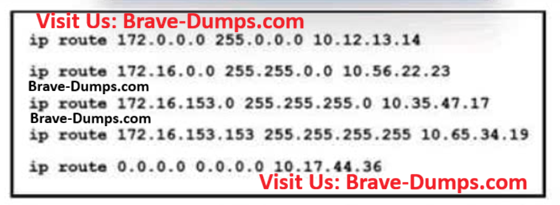
Refer to the exhibit. The static routes were implemented on the border router. What is the next hop IP address for a ping sent to 172.16.153.154 from the border router? (Choose one answer)
- A. 10.56.22.23
- B. 10.65.34.19
- C. 10.35.47.17
- D. 10.12.13.14
Question #3
What is the difference between the TCP and UDP protocols? (Choose one answer)
- A. TCP identifies devices by their MAC addresses, and UDP identifies devices by their IP address.
- B. TCP ensures ordered, reliable data delivery, and UDP offers low latency and high throughput
- C. TCP manages multicast and broadcast data transfers, and UDP only handles unicast communications.
- D. TCP discovers neighboring devices on a local network segment, and UDP prevents Layer 2 switching loops.
Question #4
What is a service that is provided by a wireless controller? (Choose one answer)
- A. It manages interference in a dense network
- B. It provides Layer 3 routing between wired and wireless devices.
- C. It mitigates threats from the internet.
- D. It issues IP addresses to wired devices.
Question #5
What is the purpose of classifying network traffic in QoS? (Choose one answer)
- A. writes the class identifier of a packet to a dedicated field in the packet header
- B. configures traffic-matching rules on network devices
- C. services traffic according to its class
- D. identifies the type of traffic that will receive a particular treatment
Question #6
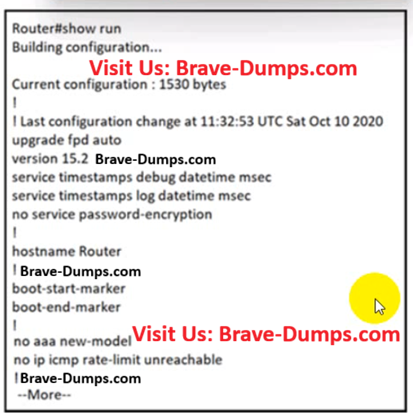
Refer to the exhibit. Which minimum configuration items are needed to enable Secure Shell version 2 access to R15? (Choose one answer)
- A. Router(config)#crypto key generate rsa general-keys modulus 1024
Router(config)#ip ssh version 2
Router(config-line)#line vty 0 15
Router(config-line)#transport input ssh
Router(config)#ip ssh logging events
R15(config)#ip ssh stricthostkeycheck - B. Router(config)#ip domain-name cisco.com
Router(config)#crypto key generate rsa general-keys modulus 1024
Router(config)#ip ssh version 2
Router(config-line)#line vty 0 15
Router(config-line)#transport input all
Router(config)#ip ssh logging events - C. Router(config)#hostname R15
R15(config)#crypto key generate rsa general-keys modulus 1024
R15(config-line)#line vty 0 15
R15(config-line)#transport input ssh
R15(config)#ip ssh source-interface fa0/0
R15(config)#ip ssh stricthostkeycheck - D. Router(config)#hostname R15
R15(config)#ip domain-name cisco.com
R15(config)#crypto key generate rsa general-keys modulus 1024
R15(config)#ip ssh version 2
R15(config-line)#line vty 0 15
R15(config-line)#transport input ssh
Question #7
How does machine learning strengthen the security measures of the network? (Choose one answer)
- A. It enforces password complexity requirements.
- B. It controls VPN access permissions.
- C. It manages firewall rule sets.
- D. It improves real-time threat detection.
Question #8
How do AAA operations compare regarding user identification, user services, and access control? (Choose one answer)
- A. Authentication identifies users, and accounting tracks user services.
- B. Authentication enforces resource access and accounting identifies a user's credentials.
- C. Authentication manages user permissions, and authorization monitors user activities.
- D. Authentication records user activities, and accounting validates user credentials.
Question #9
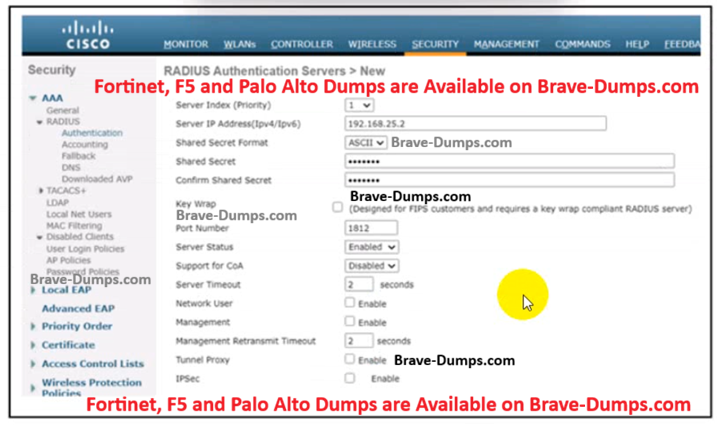
Refer to the exhibit. A network engineer configures the Cisco WLC to authenticate local wireless clients against a RADIUS server. Which action completes this configuration? (Choose one answer)
- A. Enable the Support for CoA option.
- B. Disable the Server Status option.
- C. Enable the Network User option.
- D. Enable the Management option.
Question #10
Which interface condition is occurring in this output?
R30# show interface fa0/0
FastEthernet0/0 is up, line protocol is up
Hardware is DEC21140, address is ca02.7788.0000 (bia ca02.7788.0000)
Description: madrid_subnet
Internet address is 10.32.102.2/30
MTU 1500 bytes, BW 100000 Kbit/sec, DLY 100 usec,
reliability 255/255, txload 1/255, rxload 1/255
Encapsulation ARPA, loopback not set
Keepalive (60 sec)
Half-duplex, 100BaseTX/FX
ARP type: ARPA, ARP Timeout 04:00:00
Last input 00:00:01, output 00:00:00, output hang never
Last clearing of "show interface" counters 00:00:18
Input queue: 0/30/0/0 (size/max/drops/flushes); Total output drops: 0
Queueing strategy: fifo
Output queue: 0/30 (size/max)
30 second input rate 0 bits/sec, 0 packets/sec
30 second output rate 0 bits/sec, 0 packets/sec
7331 packets input, 710112 bytes
Received 267 broadcasts (0 IP multicasts)
35 runts, 0 giants, 0 throttles
0 input errors, 0 CRC, 0 frame, 0 overrun, 0 ignored
0 watchdog
0 input packets with dribble condition detected
3927 packets output, 144403 bytes, 0 underruns
0 output errors, 480 collisions, 0 interface resets
0 unknown protocol drops
0 babbles, 0 late collision, 0 deferred
0 lost carrier, 0 no carrier
0 output buffer failures, 0 output buffers swapped out
(Choose one answer)
- A. duplex mismatch
- B. queueing
- C. high throughput
- D. bad NIC
Which IPsec mode provides encapsulation and encryption of the entire original IP packet on a site-to-site VPN? (Choose one answer)