● MS Implementing Data Engineering Solutions Using Microsoft Fabric (DP-700) Exam Materials
● Over 1 Students Passed Implementing Data Engineering Solutions Using Microsoft Fabric (DP-400) Using This Dump – Join Them Today!
● Over 70 Verified Questions for Implementing Data Engineering Solutions Using Microsoft Fabric Dump (DP-700 Dump)
● 100% Score in the Real Implementing Data Engineering Solutions Using Microsoft Fabric Exam (DP-700 Exam) at the Pearson VUE Testing Center
● Over 70 Verified Questions for Implementing Data Engineering Solutions Using Microsoft Fabric Dump (DP-700 Dump)
● 100% Score in the Real Implementing Data Engineering Solutions Using Microsoft Fabric Exam (DP-700 Exam) at the Pearson VUE Testing Center
Question #1
Question #2
You have a Fabric workspace that contains a semantic model named Model1.
You need to dynamically execute and monitor the refresh progress of Model1.
What should you use?
(Choose one answer)
- A. a semantic link in a notebook
- B. dynamic management views in Microsoft SQL Server Management Studio (SSMS)
- C. dynamic management views in Azure Data Studio
- D. Monitoring hub
Question #3
You have a Fabric workspace that contains a write-intensive warehouse named DW1. DW1 stores staging tables that are used to load a dimensional model. The tables are often read once, dropped, and then recreated to process new data.
You need to minimize load time of data from sources to staging tables in DW1.
What should you do?
(Choose one answer)
- A. Enable V-Order.
- B. Disable V-Order.
- C. Drop statistics.
- D. Create statistics.
Question #4
You have a Fabric workspace that contains a lakehouse named Lakehouse1. Lakehouse1 contains a Delta table named Table1.
You analyze Table1 and discover that Table1 contains 2,000 Parquet files of 1 MB each.
You need to minimize how long it takes to query Table1.
What should you do?
(Choose one answer)
- A. Run the OPTIMIZE and VACUUM commands.
- B. Disable V-Order and run the VACUUM command.
- C. Disable V-Order and run the OPTIMIZE command.
- D. -
Question #5
You have five Fabric workspaces.
You are monitoring the execution of items by using Monitoring hub.
You need to identify in which workspace a specific item runs.
Which column should you view in Monitoring hub?
(Choose one answer)
- A. Location
- B. Activity name
- C. Item type
- D. Submitted by
- E. Job type
- F. Capacity
- G. Start time
Question #6
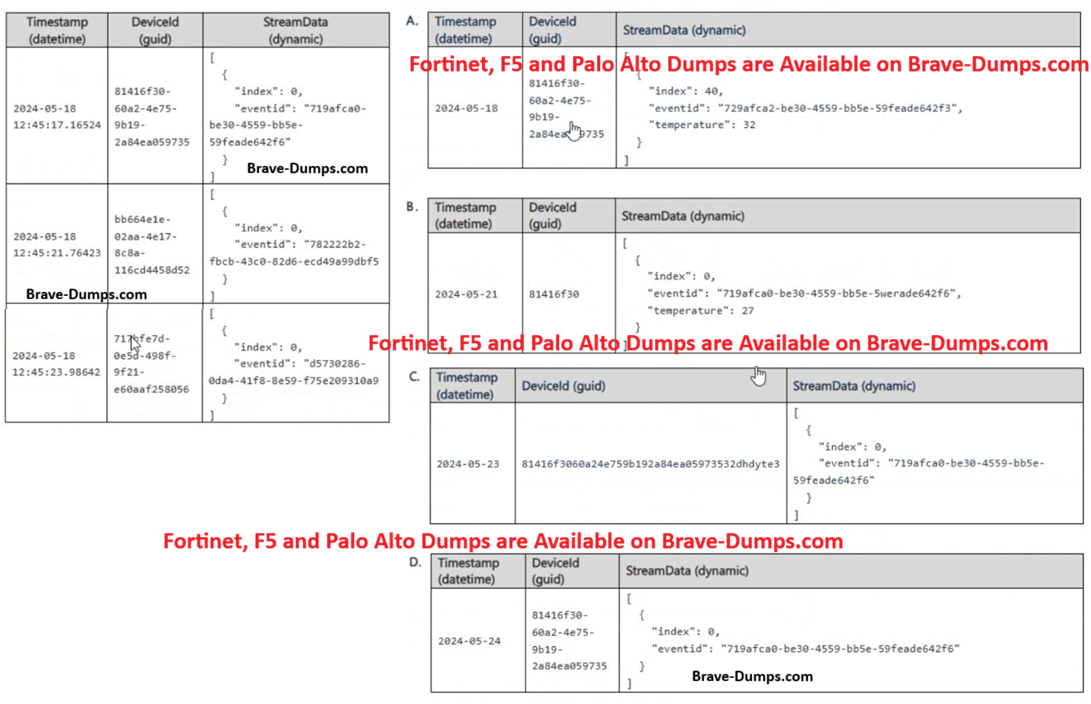
You have a Fabric workspace that contains an eventhouse and a KQL database named Database1. Database1 has the following:
A table named Table1
A table named Table2
An update policy named Policy1
Policy1 sends data from Table1 to Table2.
The following is a sample of the data in Table2.
Recently, the following actions were performed on Table1:
An additional element named temperature was added to the StreamData column.
The data type of the Timestamp column was changed to date.
The data type of the DeviceId column was changed to string.
You plan to load additional records to Table2.
Which two records will load from Table1 to Table2? Each correct answer presents a complete solution.
NOTE: Each correct selection is worth one point.
(Choose two answers)
- A. Option 1
- B. Option 2
- C. Option 3
- D. Option 4
Question #7
You have a Fabric workspace that contains a warehouse named Warehouse1. Data is loaded daily into Warehouse1 by using data pipelines and stored procedures.
You discover that the daily data load takes longer than expected.
You need to monitor Warehouse1 to identify the names of users that are currently running queries.
Which view should you use?
(Choose one answer)
- A. queryinsights.long_running_queries
- B. sys.dm_exec_connections
- C. queryinsights.frequently_run_queries
- D. sys.dm_exec_requests
- E. sys.dm_exec_sessions
Question #8
You are developing a data engineering solution in Fabric by using Apache Spark.
You need to monitor the performance of Spark workloads. The solution must meet the following requirements:
• Provide comprehensive information about the performance of the data engineering workloads.
• Identify stages and tasks that run slowly.
• Minimize administrative effort.
What should you use?
(Choose one answer)
- A. workspace metrics in Fabric
- B. the Spark UI
- C. Spark job event logs
- D. Spark application logs
Question #9
You have a Fabric workspace named Workspace1.
Your company acquires GitHub licenses.
You need to configure source control for Workspace1 to use GitHub. The solution must follow the principle of least privilege.
Which permissions do you require to ensure that you can commit code to GitHub?
(Choose one answer)
- A. Contents (Read and write) only
- B. Contents (Read) and Commit statuses (Read and write)
- C. Actions (Read and write) only
- D. Actions (Read and write) and Contents (Read and write)
Question #10
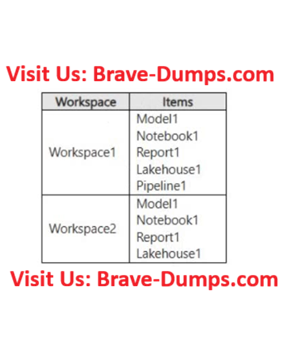
You have two Fabric workspaces named Workspace1 and Workspace2.
You have a Fabric deployment pipeline named deployPipeline1 that deploys items from Workspace1 to Workspace2. DeployPipeline1 contains all the items in Workspace1.
You recently modified the items in Workspace1.
The workspaces currently contain the items shown in the following table.
Items in Workspace1 that have the same name as items in Workspace2 are currently paired.
You need to ensure that the items in Workspace1 overwrite the corresponding items in Workspace2. The solution must minimize effort.
What should you do?
(Choose one answer)
- A. Run deployPipeline1 without modifying the items in Workspace2.
- B. Delete all the items in Workspace2, and then run deployPipeline1.
- C. Rename each item in Workspace2 to have the same name as the items in Workspace1.
- D. Back up the items in Workspace2, and then run deployPipeline1.
You have a Fabric warehouse named DW1 that loads data by using a data pipeline named Pipeline1. Pipeline1 uses a Copy data activity with a dynamic SQL source. Pipeline1 is scheduled to run every 15 minutes.
You discover that Pipeline1 keeps failing.
You need to identify which SQL query was executed when the pipeline failed.
What should you do? (Choose one answer)