● Implementing Cisco Enterprise Advanced Routing and Services (300-410 ENARSI) Exam Materials
Question #1
Question #2
How is the LDP router ID used in an MPLS network? (Choose one answer)
- A. The force keyword changes the router ID to the specified address without causing any impact.
- B. If not configured, the operational physical interface is chosen as the router ID even if a loopback is configured.
- C. The loopback with the highest IP address is selected as the router ID.
- D. The MPLS LDP router ID must match the IGP router ID.
Question #3
What are the two reasons for RD and VPNv4 addresses in an MPLS Layer 3 VPN? (Choose two answers)
- A. They are used for a BGP session with the CE device.
- B. When the PE redistributes customer routes into MP-BGP, they must be unique.
- C. RD is prepended to each prefix to make routes unique.
- D. VPN RT communities are used to identify customer unique routes.
- E. They are required for static routing.
Question #4
Which two features are required for MPLS forwarding on which types of routers? (Choose two answers)
- A. LDP on PE and core routers
- B. MPLS on PE and core routers
- C. MPLS on CE and core routers
- D. LDP on PE and CE routers
- E. CEF on PE and CE routers
Question #5
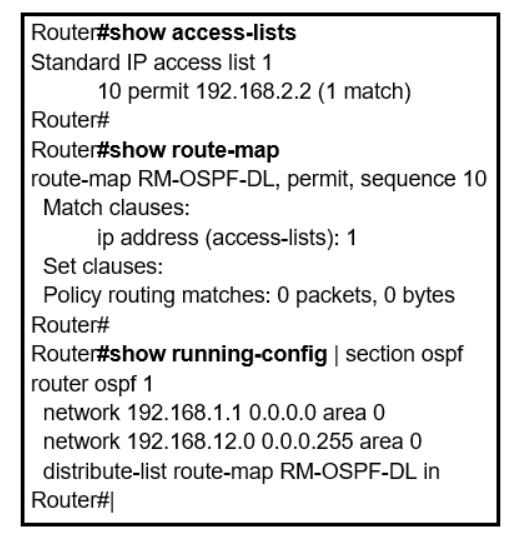
Refer to the exhibit. An engineer is trying to block the route to 192.168.2.2 from the routing table by using the configuration that is shown. The route is still present in the routing table as an OSPF route. Which action blocks the route? (Choose one answer)
- A. Use an extended access list instead of a standard access list.
- B. Add this statement to the route map: route-map RM-OSPF-DL deny 20.
- C. Use a prefix list instead of an access list in the route map.
- D. Change the action in the route map from permit to deny.
Question #6
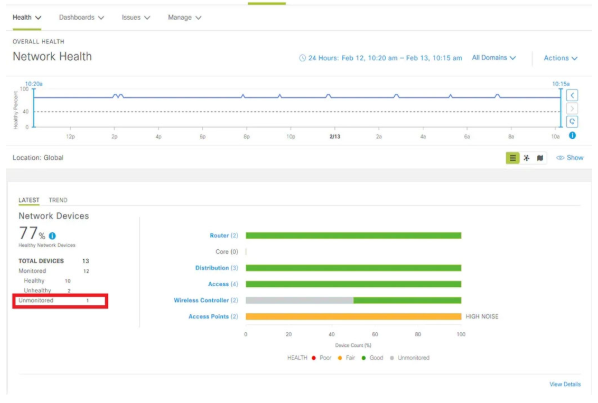
Refer to the exhibit. A network administrator added one router in the Cisco DNA Center and checked its discovery and health from the Network Health Dashboard. The network administrator observed that the router is still showing as unconfigured. What must be done to proceed? (Choose one answer)
- A. Configure router with the telemetry data.
- B. Configure router with SNMPv2c or SNMPv3 traps.
- C. Configure router with NetFlow data.
- D. Configure router with routing to reach Cisco DNA Center.
Question #7
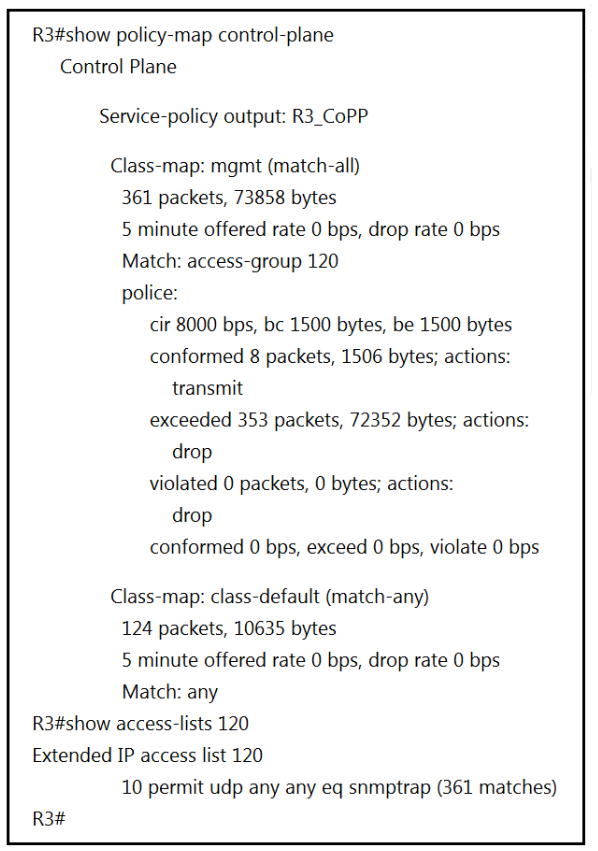
Refer to the exhibit. Which action resolves intermittent connectivity observed with the SNMP trap packets? (Choose one answer)
- A. Add a new class map to match TCP traffic.
- B. Add one new entry in the ACL 120 to permit the UDP port 161.
- C. Increase the CIR of the mgmt class map.
- D. Decrease the committed burst size of the mgmt class map.
Question #8
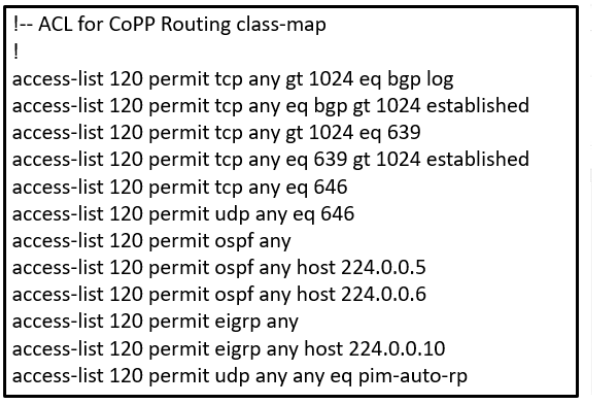
Refer to the exhibit. The control plane is heavily impacted after the CoPP configuration is applied to the router. Which command removal lessens the impact on the control plane? (Choose one answer)
- A. access-list 120 permit eigrp any host 224.0.0.10
- B. access-list 120 permit tcp any eq 1024 eq bgp log
- C. access-list 120 permit ospf any
- D. access-list 120 permit udp any any eq pim-auto-rp
Question #9
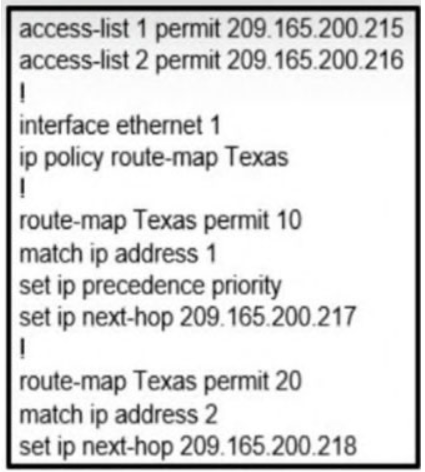
Refer to the exhibit. Packets arriving from source 209.165.200.215 must be sent with the precedence bit set to 1, and packets arriving from source 209.165.200.216 must be sent with the precedence bit set to 5. Which action resolves the issue? (Choose one answer)
- A. set ip precedence immediate in route-map Texas permit 10
- B. set ip precedence critical in route-map Texas permit 10
- C. set ip precedence priority in route-map Texas permit 20
- D. set ip precedence critical in route-map Texas permit 20
Question #10
What is a limitation of IPv6 RA Guard? (Choose one answer)
- A. It cannot be configured on a switch port interface in the ingress direction.
- B. It does not offer protection in environments where IPv6 traffic is tunneled.
- C. Packets that are dropped by IPv6 RA Guard cannot be spanned.
- D. It is not supported in hardware when TCAM is programmed.
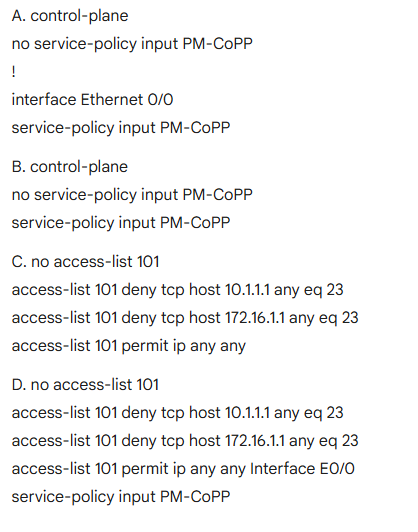
The network administrator configured R1 for Control Plane Policing so that the inbound Telnet traffic is policed to 100 kbps. This policy must not apply to traffic coming in from 10.1.1.1/32 and 172.16.1.1/32. The administrator has configured this:
access-list 101 permit tcp host 10.1.1.1 any eq 23
access-list 101 permit tcp host 172.16.1.1 any eq 23
!
class-map CoPP-TELNET
match access-group 101
!
policy-map PM-CoPP
class CoPP-TELNET
police 100000 conform transmit exceed drop
!
control-plane
service-policy input PM-CoPP
The network administrator is not getting the desired results. Which set of configurations resolves this issue? (Choose one answer)