● BIG-IP Administration Data Plane Configuration (F5CAB3)
Question #1
Question #2
A BIG-IP Administrator finds the following log entry after a report of user issues connecting to a virtual server:
01010201: Intercept exhaustion on 10.70.110.112 to 192.28.123.250:80 (proto 6)
How should the BIG-IP Administrator modify the SNAT pool that is associated with the virtual server?
(Choose one answer)
- A. Increase the timeout of the SNAT addresses
- B. Remove the SNAT pool and apply SNAT Automap
- C. Remove an IP address from the SNAT pool
- D. Add an IP address to the SNAT pool
Question #3
A BIG-IP Administrator uses backend servers to host multiple services per server. There are multiple virtual servers and pools defined, referencing the same backend servers.
Which load balancing algorithm is most appropriate to have an equal number of connections on each backend server?
(Choose one answer)
- A. Least Connections (node)
- B. Predictive (member)
- C. Least Connections (member)
- D. Predictive (node)
Question #4
The BIG-IP Administrator is investigating if better TCP performance is possible for a virtual server.
Which built-in profile should be tried first?
(Choose one answer)
- A. f5-tcp-legacy
- B. f5-tcp-progressive
- C. f5-tcp-mobile
- D. No option
Question #5
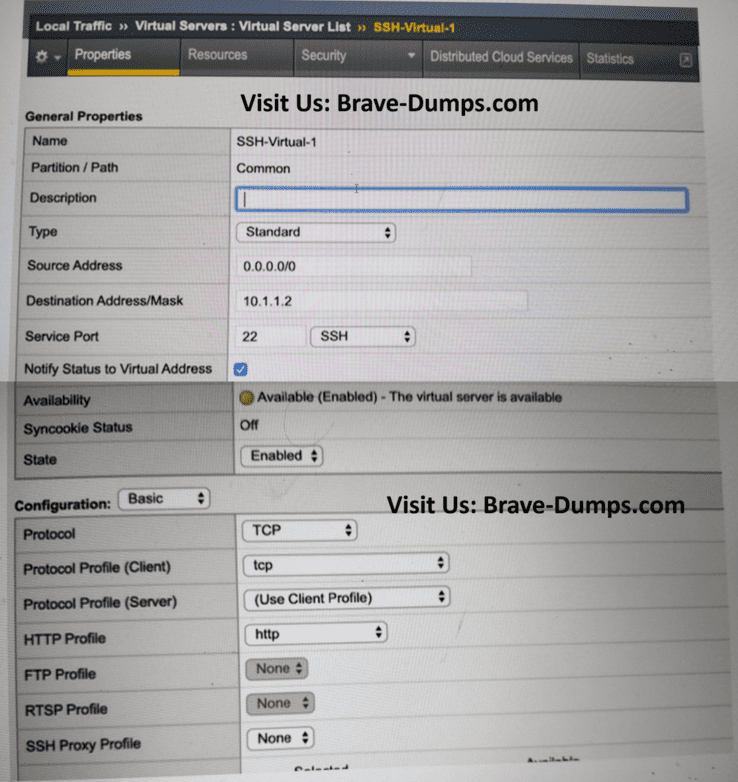
Refer to the exhibit.
A BIG-IP Administrator creates a new Virtual Server to load balance SSH traffic. Users are unable to log on to the servers.
What should the BIG-IP Administrator do to resolve the issue?
(Choose one answer)
- A. Set Protocol to UDP
- B. Set Source Address to 10.1.1.2
- C. Set Destination Address/Mask to 0.0.0.0/0
- D. Set HTTP Profile to None
Question #6
The BIG-IP Administrator needs to load balance a pool of web servers. Load balancing should consider the number of connections that are active on that pool member.
Which load balancing method meets this requirement?
(Choose one answer)
- A. Least Connections (member)
- B. Round Robin
- C. Ratio (member)
- D. Ratio (node)
Question #7
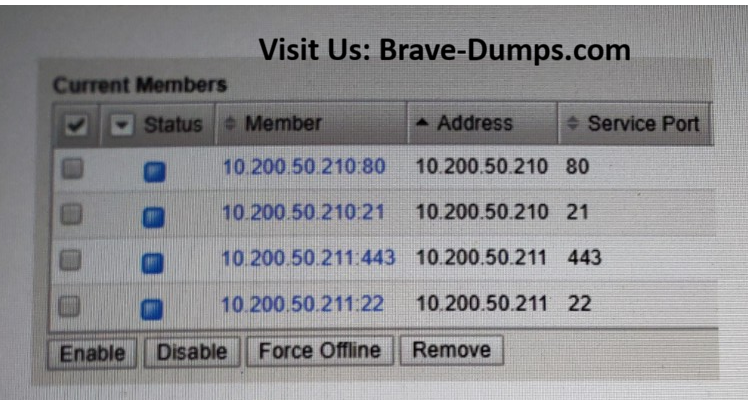
Refer to the exhibit.
A BIG-IP Administrator needs to configure health monitors for a newly configured server pool named Pool_B.
Which health monitor settings will ensure that all pool members will be accurately marked as available or unavailable?
(Choose one answer)
- A. HTTPS, HTTP, FTP, and SSH with the Availability Requirement of all health monitors
- B. HTTP, HTTPS, FTP, and ICMP with the Availability Requirement of at least one health monitor
- C. HTTPS, HTTP, FTP, and SSH with the Availability Requirement of at least one health monitor
- D. HTTPS, HTTP, FTP, and SSH with the Availability Requirement of all health monitors
Question #8
All pool members are online. All other virtual server settings are at default.
What might alter the load balancing behavior?
(Choose one answer)
- A. Adding a oneconnect profile
- B. Enabling SNAT automap
- C. Enabling a fallback host in the HTTP profile
- D. Adding a persistence profile
Question #9
Which persistence profile would be the most appropriate to ensure an HTTP web request connects to the same pool member? (Choose one answer)
- A. destination address
- B. hash persistence
- C. SSL persistence
- D. cookie persistence
Question #10
A BIG-IP Administrator needs to apply persistence to a virtual server that is configured as a Performance (Layer 4) virtual server that allows access to a secure (TLS) e-commerce website.
What type of persistence profile can be used?
(Choose one answer)
- A. Source Address Affinity
- B. Cookie persistence
- C. Microsoft RDP persistence
- D. Host persistence
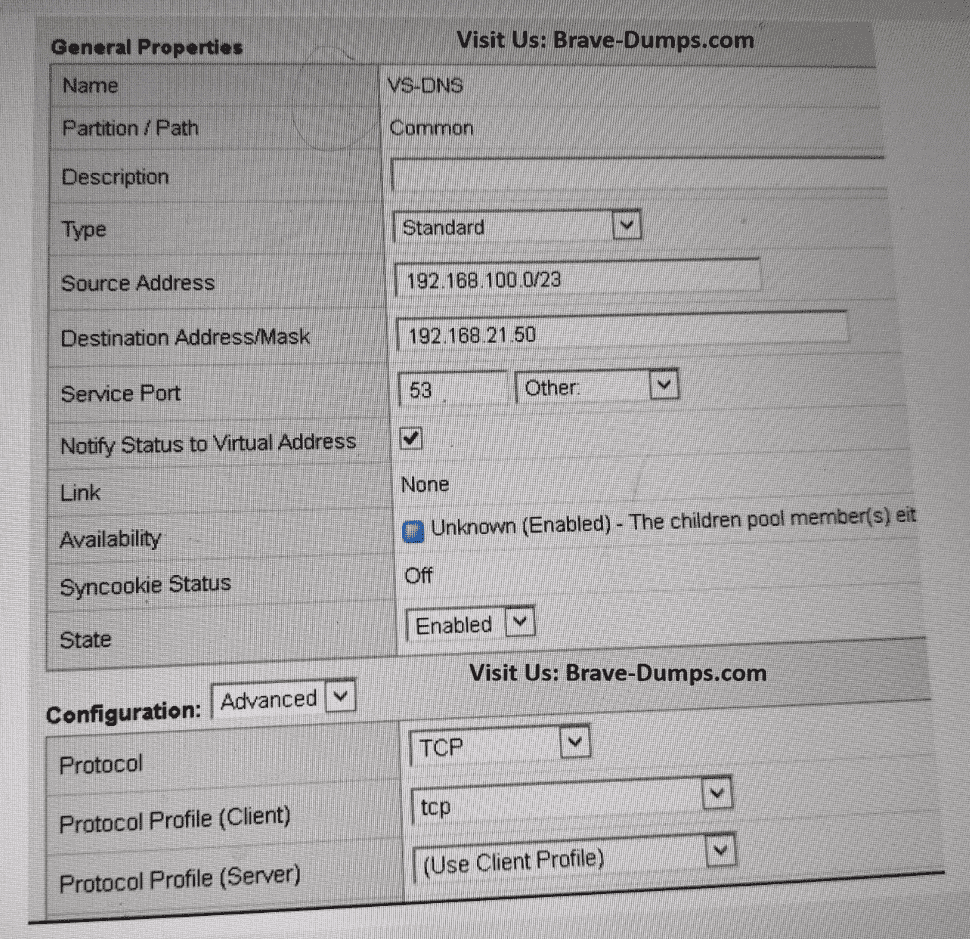
Refer to the exhibit.
DNS queries from two internal DNS servers are being load-balanced to external DNS servers via a virtual server on a BIG-IP device. The DNS queries originate from:
192.168.10.100
192.168.10.200
and target:
192.168.2.150
All DNS queries destined for the external DNS servers fail.
Which property change should the BIG-IP Administrator make in the Virtual Server to resolve this issue? (Choose one answer)