● NSE 5 - FortiManager 7.6 Administrator Exam Materials
● Over 100 Students Passed FortiManager 7.6 Administrator (FCP_FMG_AD-7.6) Using This Dump – Join Them Today!
● Less Than 100 Verified Questions for the NSE 5 - FortiManager 7.6 Administrator Dump (FMG_AD-7.6 Dump)
● 100% Score in the Real FortiManager 7.6 Administrator Exam (FMG_AD-7.6 Exam) at the Pearson VUE Testing Center
● Less Than 100 Verified Questions for the NSE 5 - FortiManager 7.6 Administrator Dump (FMG_AD-7.6 Dump)
● 100% Score in the Real FortiManager 7.6 Administrator Exam (FMG_AD-7.6 Exam) at the Pearson VUE Testing Center
Question #1
Question #2
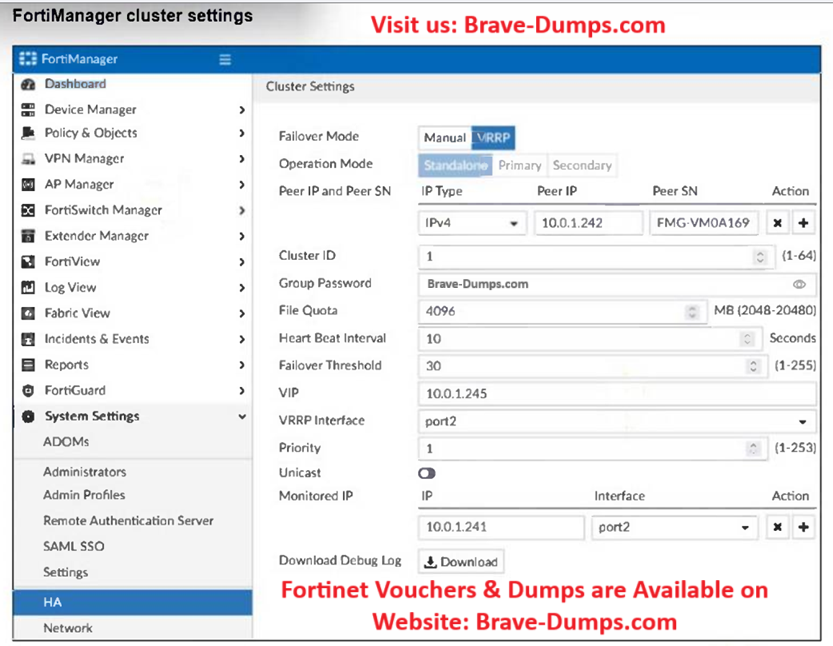
Refer to the exhibit.
If the monitored interface for the primary FortiManager device fails, what must you do to maintain high availability (HA)?
(Choose one answer)
- A. The FortiManager HA failover is transparent to administrators and does not require any additional action.
- B. Manually promote one of the working secondary devices to the primary role, and reboot the original primary device to remove the peer IP address of the failed device.
- C. Reconfigure the primary device to remove the peer IP address of the failed device from its configuration.
- D. Check the integrity database of the primary device to force a secondary device to become the new primary with all active interfaces.
Question #3
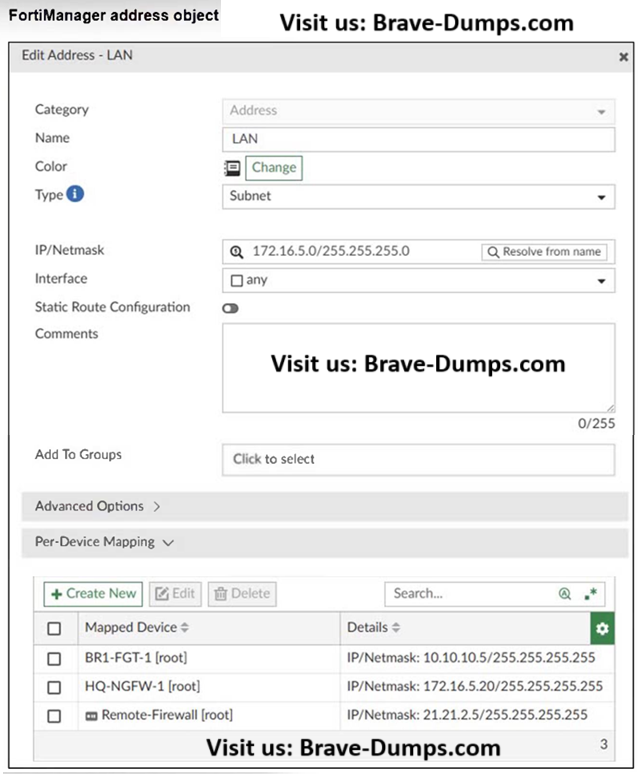
Refer to the exhibit.
An administrator has created a firewall address object that is used in multiple policy packages for multiple FortiGate devices in an ADOM.
After the installation operation is performed, which IP/netmask will be installed on Remote-Firewall [VDOM1] for the LAN firewall address object?
(Choose one answer)
- A. 21.21.2.5/255.255.255.255
- B. 172.16.5.20/255.255.255.255
- C. 172.16.5.0/255.255.255.0
- D. 10.10.10.5/255.255.255.255
Question #4
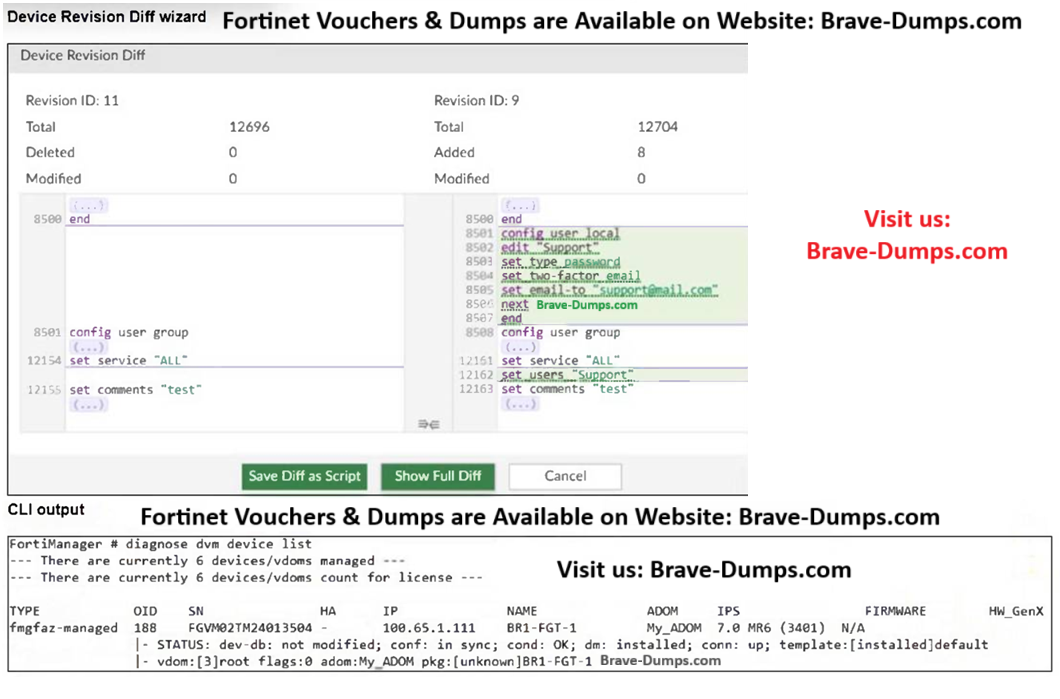
Refer to the exhibits.
An administrator needed to recover all the configurations related to the user, Support. The configurations were saved in configuration revision ID 9.
The administrator reverted the configuration using the Configuration Revision History window and received the CLI output shown in the exhibit.
What can you conclude from the CLI output?
(Choose one answer)
- A. The administrator set the flag to 0 to prevent configuration overrides.
- B. The administrator reinstalled the policy package.
- C. The administrator needs to retrieve the device to correctly detect the FortiGate firmware version.
- D. The administrator installed only the device-level configuration.
Question #5
An administrator wants to configure and manage multiple objects in the FortiManager database and give access to other users who work in the same database.
To stay in control of the changes made to firewall policies by other team members, the administrator needs a setup where all modifications go through a central check before they can be installed.
How can the administrator create this setup?
(Choose one answer)
- A. Enable the prompt asking the administrator to accept firewall policies changes before saving.
- B. Enable the workspace (for all ADOMs) to control all changes made by any administrator.
- C. Enable device lock and the advanced mode feature in the ADOM.
- D. Enable workflow mode and the ADOM lock feature.
Question #6
Which two conditions trigger FortiManager to create a new revision history? (Choose two answers)
- A. When FortiManager installs device-level changes on a managed device
- B. When changes to the device-level database are made on FortiManager
- C. When FortiManager is auto-updated with configuration changes made directly on a managed device
- D. When a provisioning template is assigned to a managed device on the device-level database
Question #7
An administrator has assigned a global policy package to a new ADOM named ADOM1.
What will happen if the administrator tries to create a new policy package in ADOM1?
(Choose one answer)
- A. The administrator will be able to select the option to assign the global policy package to the new policy package.
- B. FortiManager will automatically assign the global policy package to the new policy package.
- C. FortiManager will automatically install policies on the policy package in ADOM1.
- D. The administrator will have to assign the global policy package from the global ADOM.
Question #8
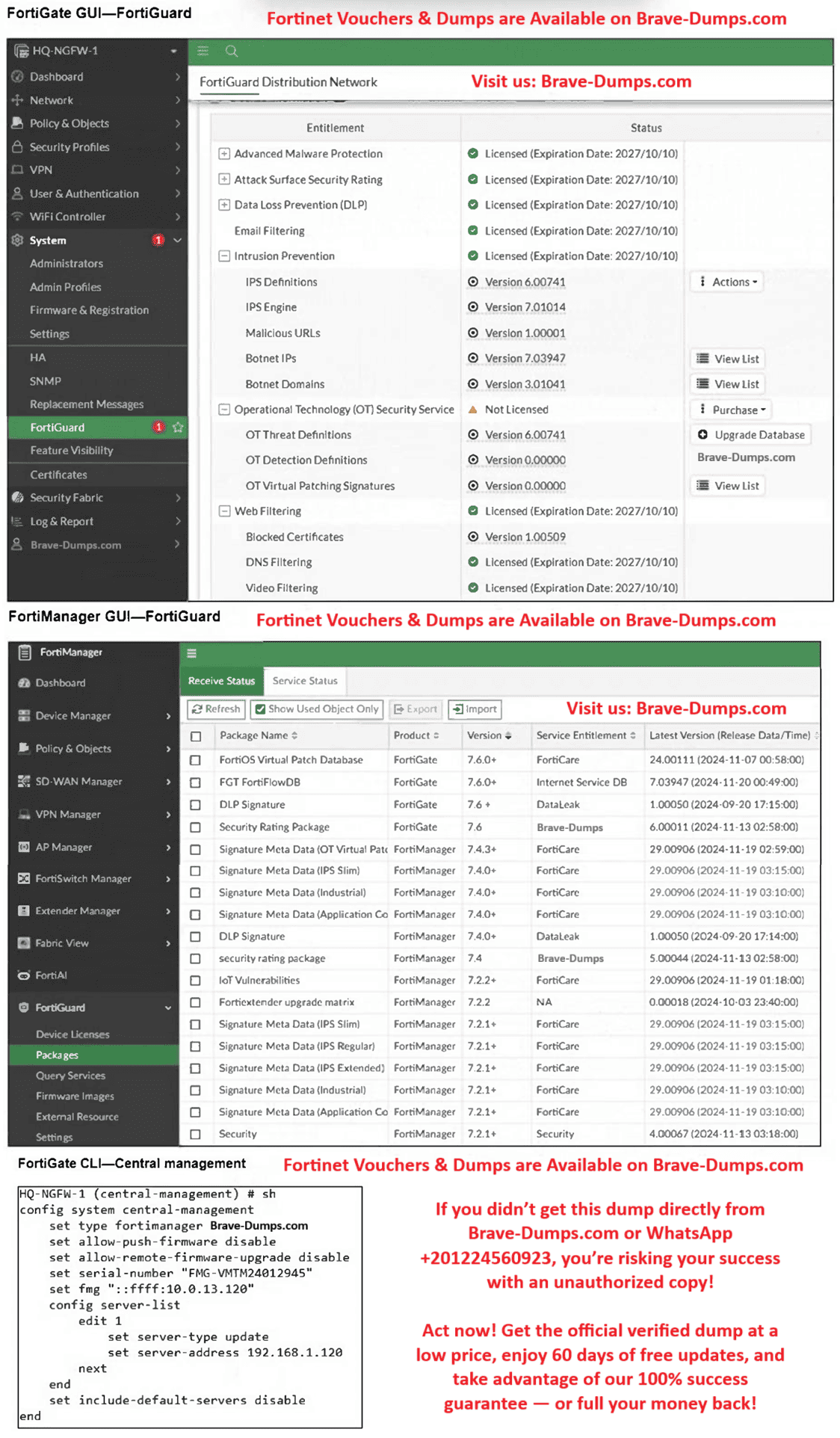
Refer to the exhibits.
FortiGate HQ-NGFW-1 downloads and validates FortiGuard databases from FortiManager, which acts as a local FortiGuard Distribution Server (FDS) in a closed network. An administrator pushes a new firewall policy with an intrusion prevention system (IPS) profile from FortiManager to FortiGate HQ-NGFW-1. However, FortiGate does not recognize the new IPS signature from FortiManager.
What is the most likely reason why FortiGate HQ-NGFW-1 does not recognize the new IPS signature?
(Choose one answer)
- A. FortiGate must enable rating for the FortiManager IP address, 192.168.1.120, in server list 1.
- B. FortiManager and FortiGate have different IPS database versions.
- C. The administrator must enable IPv6 connections for FortiGuard services on FortiManager.
- D. The administrator must enable the fortiguard-anycast option to correctly download all signatures from the local FDS.
Question #9
Which is recommended when you are managing a high volume of logs in your network? (Choose one answer)
- A. Store logs on FortiManager and use FortiView.
- B. Add and manage FortiAnalyzer from FortiManager.
- C. Enable advanced ADOM mode on FortiManager.
- D. Forward logs from FortiAnalyzer to FortiManager daily.
Question #10
While attempting to push a NetFlow configuration script through the FortiManager policy package, an administrator encounters an error stating that an object is unrecognized in line 4.
Starting log (Run on database)
config vdom
edit AGEUSR
[line 4] > config sys interface [parameter(s) invalid. detail: object unrecognized]
Failed to commit to DB, reason ([line 4] > config sys interface [parameter(s) invalid. detail: object unrecognized])
Running script(NetFlow_Configuration) on DB failed
What must the administrator do to successfully apply the NetFlow configuration script and avoid the object unrecognized error?
(Choose one answer)
- A. Make sure the user running the script has full access to the VDOM—AGEUSR.
- B. Run the script on the device database.
- C. Use metadata variables if they use VDOMs in the script.
- D. Create a normalized interface on the policy layer before running the script.
You want to let multiple administrators work in the same ADOM without creating configuration conflicts.
What is the best and the most effective solution to apply? (Choose one answer)