● FCSS - Enterprise Firewall 7.4 Administrator Exam Materials
Please note that the exam "FCSS - Enterprise Firewall 7.4 Administrator Exam" is no longer offered by Fortinet and is not available for booking through Pearson VUE, so we opened it on free view,
It has been replaced by the exam "NSE 7 - Enterprise Firewall 7.6 Administrator"
The new exam version is available on Brave-Dumps and can be purchased.
It has been replaced by the exam "NSE 7 - Enterprise Firewall 7.6 Administrator"
The new exam version is available on Brave-Dumps and can be purchased.
Question #11
Question #12
An administrator is extensively using VXLAN on FortiGate.
Which specialized acceleration hardware does FortiGate need to improve its performance?
(Choose one answer)
- A. NP7
- B. SP5
- C. СР9
- D. NTurbo
Question #13
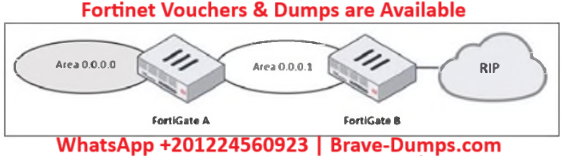
Refer to the exhibit, which shows a partial enterprise network.
An administrator would like the area 0.0.0.0 to detect the external network.
What must the administrator configure؟
(Choose one answer)
- A. Enable RIP redistribution on FortiGate B.
- B. Configure a distribute-route-map-in on FortiGate B.
- C. Configure a virtual link between FortiGate A and B.
- D. Set the area 0.0.0.l type to stub on FortiGate A and B.
Question #14
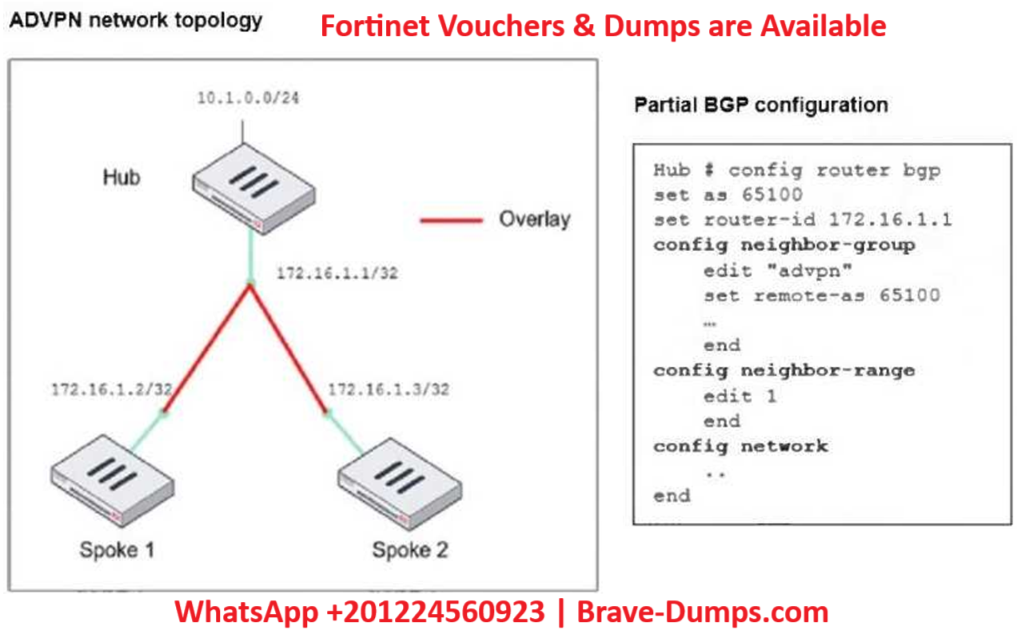
Refer to the exhibit, which shows the ADVPN network topology and partial BGP configuration.
Which two parameters must an administrator configure in the config neighbor range for spokes shown in the exhibit?
(Choose two answers)
- A. set max-neighbor-num 2
- B. set neighbor-group advpn
- C. set route-reflector-client enable
- D. set prefix 172.16.1.0 255.255.255.0
Question #15
Which two statements about IKEv2 are true if an administrator decides to implement IKEv2 in the VPN topology? (Choose two answers)
- A. It includes stronger Diffie-Hellman (DH) groups, such as Elliptic Curve (ECP) groups.
- B. It supports interoperability with devices using IKEv1.
- C. It exchanges a minimum of two messages to establish a secure tunnel.
- D. It supports the extensible authentication protocol (EAP).
Question #16
An administrator must enable direct communication between multiple spokes in a company's network.
Each spoke has more than one internet connection.
The requirement is for the spokes to connect directly without passing through the hub, and for the links to automatically switch to the best available connection.
How can this automatic detection and optimal link utilization between spokes be achieved?
(Choose one answer)
- A. Set up OSPF routing over static VPN tunnels between spokes.
- B. Utilize ADVPN 2.0 to facilitate dynamic direct tunnels and automatic link optimization.
- C. Establish static VPN tunnels between spokes with predefined backup routes.
- D. Implement SD-WAN policies at the hub to manage spoke link quality.
Question #17
What does the command set forward-domain <domain_ID> in a transparent VDOM interface do? (Choose one answer)
- A. It configures the interface to prioritize traffic based on the domain ID, enhancing quality of service for specified VLANs.
- B. It isolates traffic within a specific VLAN by assigning a broadcast domain to an interface based on the VLAN ID.
- C. It restricts the interface to managing traffic only from the specified VLAN, effectively segregating network traffic.
- D. It assigns a unique domain ID to the interface, allowing it to operate across multiple VLANs within the same VDOM
Question #18
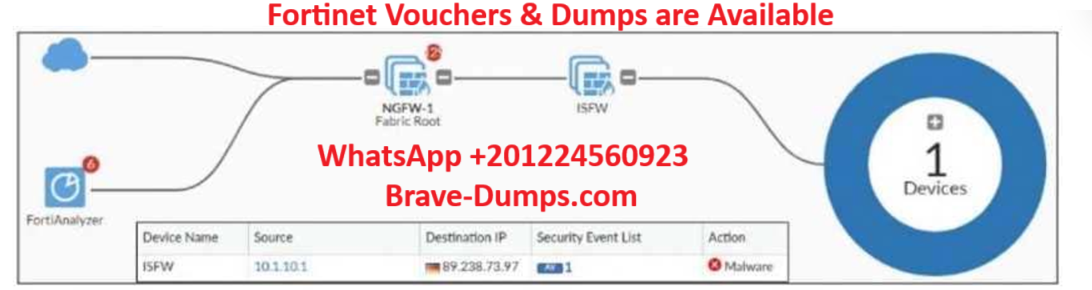
Refer to the exhibit, which shows a physical topology and a traffic log.
The administrator is checking on FortiAnalyzer traffic from the device with IP address 10.1.10.1, located behind the FortiGate ISFW device.
The firewall policy in on the ISFW device does not have UTM enabled, and the administrator is surprised to see a log with the action Malware, as shown in the exhibit.
What are the two reasons FortiAnalyzer would display this log?
(Choose two answers)
- A. Security rating is enabled in ISFW.
- B. ISFW is in a Security Fabric environment.
- C. ISFW is not connected to FortiAnalyzer and must go through NGFW-1.
- D. The firewall policy in NGFW-1 has UTM enabled.
Question #19
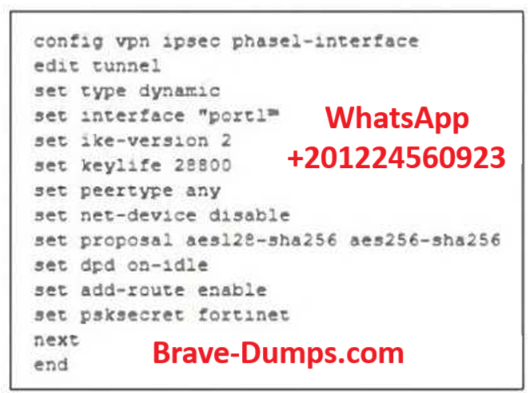
Refer to the exhibit, which contains a partial VPN configuration.
What can you conclude from this VPN IPsec phase 1 configuration?
(Choose one answer)
- A. This configuration is the best for networks with regular traffic intervals, providing a balance between connectivity assurance and resource utilization.
- B. Peer IDs are unencrypted and exposed, creating a security risk.
- C. FortiGate will not add a route to its routing or forwarding information base when the dynamic tunnel is negotiated.
- D. A separate interface is created for each dial-up tunnel, which can be slower and more resource intensive, especially in large networks.
Question #20
A company's users on an IPsec VPN between FortiGate A and B have experienced intermittent issues since implementing VXLAN.
The administrator suspects that packets exceeding the 1500-byte default MTU are causing the problems.
In which situation would adjusting the interfaces maximum MTU value help resolve issues caused by protocols that add extra headers to IP packets?
(Choose one answer)
- A. Adjust the MTU on interfaces only if FortiGate has the FortiGuard enterprise bundle, which allows MTU modification.
- B. Adjust the MTU on interfaces in all FortiGate devices that support the latest family of Fortinet SPUs: NP7, CP9 and SP5.
- C. Adjust the MTU on interfaces in controlled environments where all devices along the path allow MTU interface changes.
- D. Adjust the MTU on interfaces only in wired connections like PPPoE, optic fiber, and ethernet cable.
An administrator applied a block-all IPS profile for client and server targets to secure the server, but the database team reported the application stopped working immediately after.
How can an administrator apply IPS in a way that ensures it does not disrupt existing applications in the network? (Choose one answer)