View all questions & answers for the FCSS - Enterprise Firewall 7.4 Administrator Exam Materials exam
FCSS - Enterprise Firewall 7.4 Administrator Exam Materials-Question 19 Discussion
Comments
Selected Answers: A
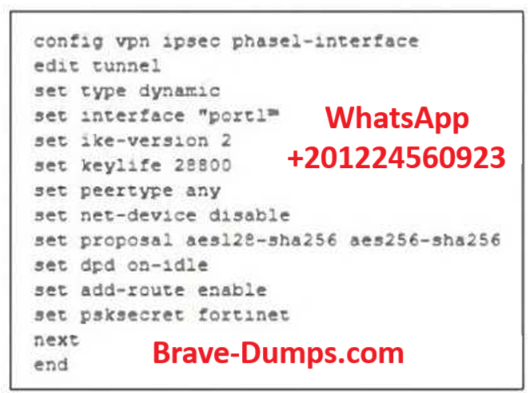
Dynamic → Dial-Up VPN.
The remote peer is the one who initiates the connection, and we often do not know its IP address.
set ike-version 2
Uses IKEv2 ➔ modern, more secure and more efficient.
set net-device disable
A virtual network interface is not created for each connection.
set add-route enable
Route is added automatically after successful connection (add-route enable).
_____________________
B is not correct:
In IKEv1 aggressive mode, peer IDs are unencrypted and exposed, creating a security risk. Conversely
It would have been correct if on the configuration is ike v1 not v2
C is not correct:
set add-route enable
Route is added automatically after successful connection (add-route enable).
D is not correct
set net-device disable
It would have been correct if nat-device is enabled
A is correct:
set dpd on-idle
EFW 7.4 page 195 confirms that:
"On-idle mode is best for networks with regular traffic intervals, providing a balance between connectivity assurance and resource utilization."
Refer to the exhibit, which contains a partial VPN configuration. What can you conclude from this VPN IPsec phase 1 configuration? (Choose one answer)
Brave-Dump Clients Votes