View all questions & answers for the NSE 7 - Enterprise Firewall 7.6 Administrator Exam Materials exam
NSE 7 - Enterprise Firewall 7.6 Administrator Exam Materials-Question 43 Discussion
Comments
Selected Answers: A
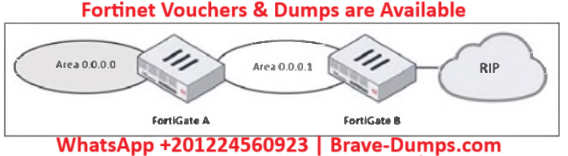
Redistribution is key: FortiGate B acts as an Area Border Router (ABR) and the boundary between the RIP routing domain and the OSPF backbone (Area 0.0.0.0). By default, routing protocols do not share the routes they learn with other routing protocols. To make the RIP-learned prefixes known to the OSPF network, you must explicitly configure route redistribution on the common router, FortiGate B.
FortiGate B's Role: In the OSPF configuration on FortiGate B, you need to enable the redistribution of "rip" routes into the OSPF domain.
How it works: Once redistributed, the RIP routes are injected into the OSPF backbone as External Type 5 Link-State Advertisements (LSAs) and propagated to all other OSPF routers, including FortiGate A
Selected Answers: A
"An ASBR redistributes non-OSPF routes into the OSPF network."
---
"Type 5 LSAs are sent only by the ASBRs and are not confined to one area. They reach all the standard areas. They contain link state information for routes redistributed to OSPF (also called external routes)."
---
"Type 5 LSAs are not advertised to stub or NSSAs."
Backbone area (area 0) can't be stub area or nssa anyway, so answer is A
Selected Answers: A
Refer to the exhibit. A partial enterprise network is shown. What must you configure so that FortiGate A and other OSPF routers in the backbone learn about prefixes generated within the RIP domain? (Choose one answer)
Brave-Dump Clients Votes