View all questions & answers for the NSE 4 - FortiOS 7.6 Administrator Exam Materials exam
NSE 4 - FortiOS 7.6 Administrator Exam Materials-Question 70 Discussion
Comments
Selected Answers: A, C
Selected Answers: B, C
Selected Answers: B, C
defencedev.com
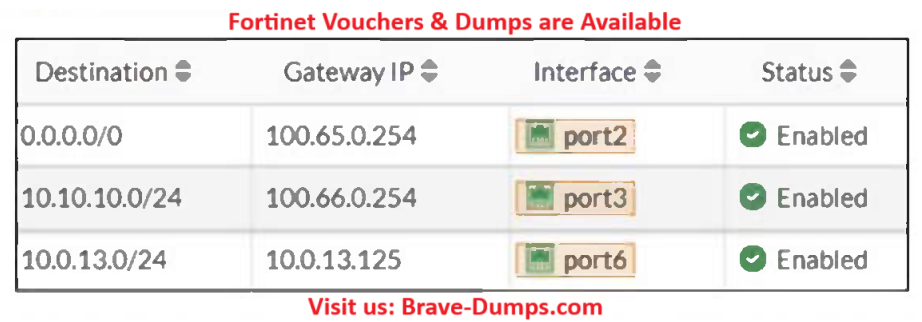
. For a source of 10.10.10.10, the routing table shows the return path is via the 10.10.10.0/24 route on port 3. If such a packet arrives on port 2, the return path doesn’t match and strict RPF drops it.
Option A is not considered correct in the exam, even though it can appear reasonable. When strict RPF is disabled, FortiGate uses loose RPF, which permits a packet as long as there is a route back to the source
defencedev.com
. In this case the only route back to 10.100.110.10 is the default route via port 2, not the incoming port 3. Exam guidance takes a conservative view that, without a more specific route to the source (and with no RPF enabled on that interface), such a packet would not be accepted. Hence, the exam omits Option A and selects only B and C as the correct answers.
Based on the routing table shown in the exhibit, which two statements are true? (Choose two answers)
Brave-Dump Clients Votes